Like a fast-food burger in a billboard ad, AI looks flawless at first glance. Vítor Carvalhinho, UX Specialist at Tangível, unpacks the hidden complexity of AI and why ethical technology comes down to good old-fashioned usability.
TOPICS
UX Design
UX Strategy
Research
Service Design
SHARE
A few days ago, the Tangível marketing team wanted to save me some work. Yesterday was World Usability Day, this year’s theme is Ethical Artificial Intelligence, and my calendar is bursting at the seams. So, with the best of intentions, they asked ChatGPT for an article “by me” on the subject.
And poof… an article appeared, magically and automatically. Knowing our team, I bet they were careful with the prompt, gave context and refined the request several times. They read it and thought it was good. “Above average,” ChatGPT itself agreed.
I read it with curiosity. It was well written. At first glance it was relevant. It was something I would have written. But on a second read: a typo here, a claim there that I’m not sure is true. On a third, something I would have done differently, an example that was missing. And I found myself not only rewriting whole paragraphs but also rethinking the entire article.
Everything was right and everything was wrong.
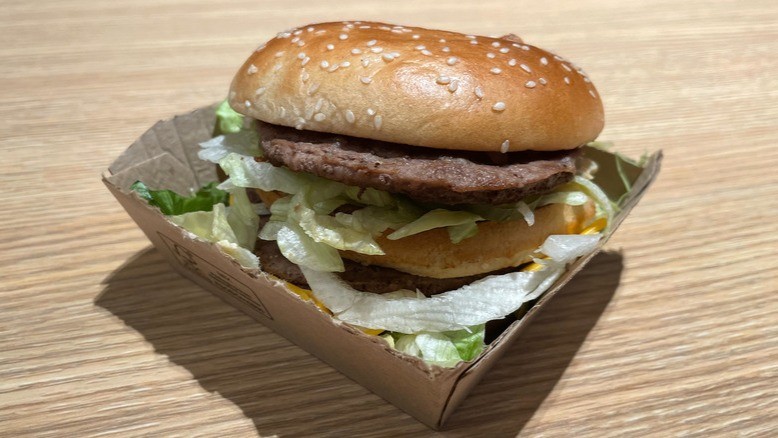
And it reminded me of… a Big Tasty.
Which, I confess, I also eat from time to time. In the ads, man, it really does look tasty. Tall and glossy, with the cheese dripping down. But on the tray, in the car, at two in the morning, alone… is it really big? Is it really tasty? Is it really “an unforgettable pleasure!”?
AI shows up in our lives in two ways:
In the product people use: the assistant, the automatic summary, the smart suggestion.
And in the process of those who make those products: the prototype generated in minutes, synthetic users, vibe coding.
And, in both cases, the first picture looks perfect. But the serious question remains: is it really tasty?
The problems don’t disappear. They move.
Tangível was born because of a book by Don Norman, The Design of Everyday Things, and of an idea: simplifying the world through design.
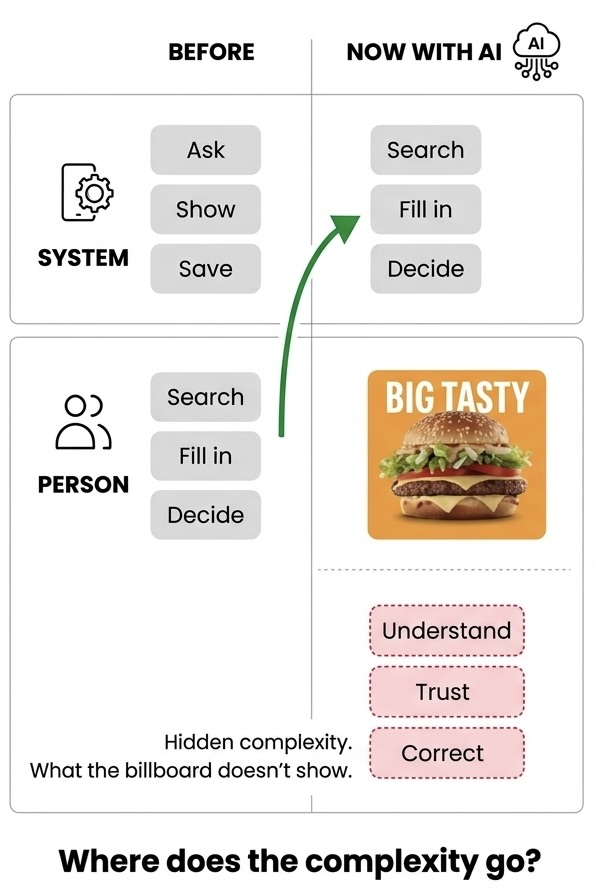
For more than twenty years, I have spent my days watching people use things. Hospitals, Social Security letters, income tax filing, MB WAY. I always keep Tesler’s Law in mind: complexity doesn’t disappear, but it can be moved from the person to the system. In practice, it comes down to asking: “Can’t the app, the service or the company deduce, infer, calculate, translate or do this for us?”
In 2026, more than ever, the answer is yes. AI writes, summarizes, fills in, suggests. AI is the greatest automagic ever.
But even with AI, not all the complexity evaporates. It moves to a new, more hidden place: the moment when the person has to understand what the AI did, decide whether to trust it, and correct it when it gets things wrong.
Norman describes three levels at which we react to things. The Big Tasty billboard wins us over at the visceral level: the first impression, the “Wow!” But, just like in the ChatGPT article, there are problems hidden under the cheese:
the solution is right, but the problem is wrong;
the solution is good in theory, but unsuited to the real context;
it is correct in the details, but wrong in the concept;
it is acceptable, but something exceptional was needed;
it works for the average global customer, but fails in the local culture.
Working out whether something made with AI, or a product that uses AI, is truly good requires another level, the reflective one. That is, it takes time. Letting the dazzle pass and looking carefully. Methodically, one persona at a time, one scenario at a time. With design and human factors principles in mind. With Microsoft’s Guidelines for Human-AI Interaction. With Tony Ulwick’s outcomes.
The easy usability problems will get easier, and anyone will be able to solve them with AI. The hard ones will still be there, hidden like the Big Tasty’s flaws on the billboard. And the cost will arrive later.
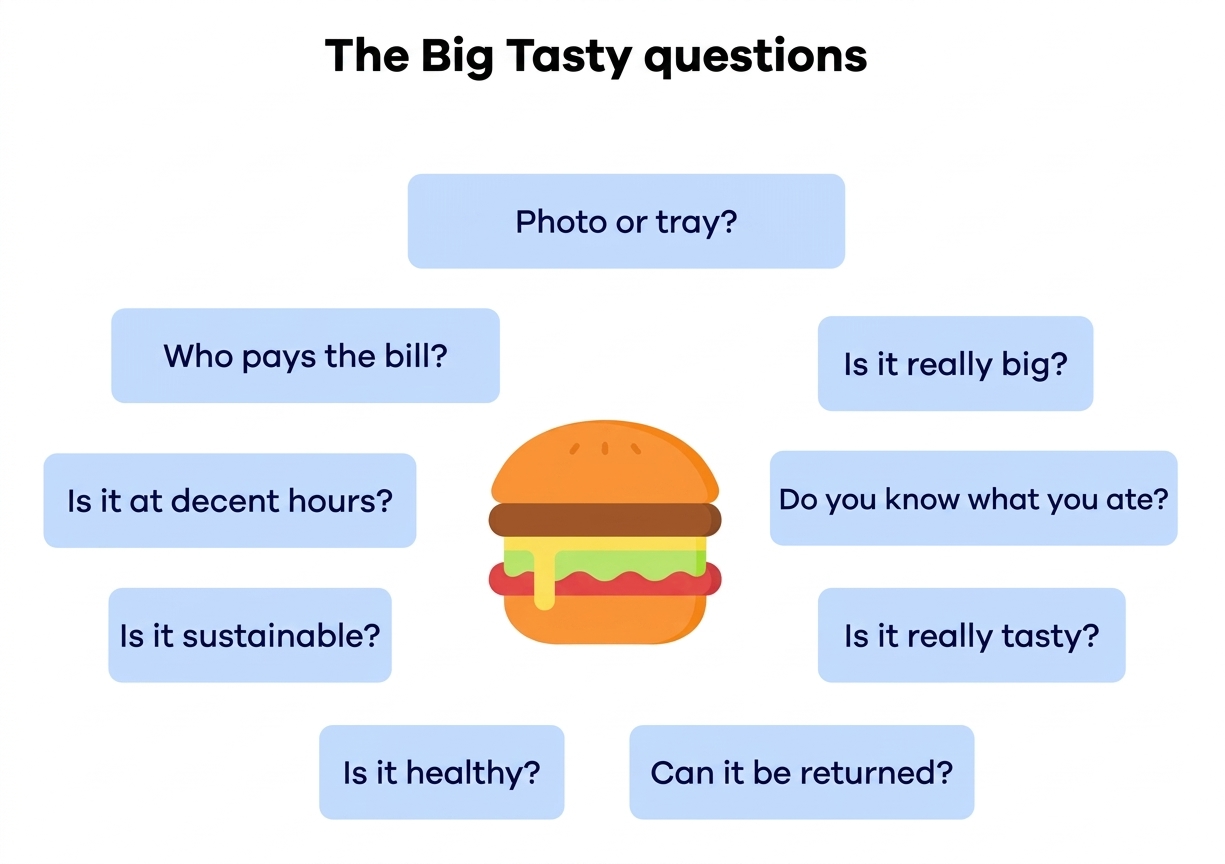
The Big Tasty questions
When an AI product or a piece of AI-made work lands on our tray, there are a few questions to ask before the first bite.
Photo or tray?
The burgers in ads are prepared for the camera, not for the stomach. AI solutions are too: focus on the visuals, clean data and the ideal path. With synthetic justifications to go with them. And, more and more, already validated with synthetic “users.”
All of this has low ecological validity. It is critical to stop, adjust and validate properly.
At Tangível, we use the speed of AI not to finish sooner, but to explore more. We don’t jump straight to high fidelity or to Figma:
we make storyboards with AI to validate ideas at a high level,
and interactive sitemaps with Octopus AI for information architecture.
Then we use AI to add realistic data and micro-interactions to the prototypes, and we test with real people, in real contexts. AI supercharges the already powerful RITE method: the concept in a wireframe on Monday, the navigation in an interactive prototype on Wednesday, the micro-interactions in a vibe-coded system on Friday.
the centaur, a person who is helped by themachine;
and the reverse centaur, a personput at the machine’s service.
At Tangível we want to be centaurs: the headis human, and AI is the body that helps us go further.
Is it really big?
Does it do what it promises? It sounds like an obvious question, but with AI the promise is huge and the delivery is hard. It is no coincidence that the first two of Microsoft’s 18 guidelines for human-AI interaction are:
make clear what the system can do,
and make clear how well it can do it.
Overpromising ruins trust before the first bite.
An older case helps show what is at stake. In Santander’s business online banking, anyone making a transfer had to choose the protocol: SEPA, SWIFT, and so on. Choosing wrong cost money. The solution we came up with at the time was a single form in which the system deduced the protocol.
With AI, these deductions become more ambitious but less predictable. If the AI doesn’t show what it deduced, if it doesn’t stop to ask, if it doesn’t create enough friction for the person to truly see before confirming, the error may only show up after the money has already left.
Do you know what you ate?
The ingredients are on the Big Tasty’s label. Almost nobody reads it.
This is the “gulf of evaluation,” the distance between what a system did and what the person can tell it did. It is a central problem in AI. A fluent answer, an interview transcript, a generated prototype doesn’t tell you what it ignored, or how sure it is.
A good AI should show:
what it is based on,
what was left out,
and how certain it is.
Is it really tasty?
AI writes and designs beautifully. And that is part of the problem.
It is the aesthetic-usability effect: we find beautiful things easier to use and more trustworthy. A well-written, polite, confident text convinces before it is verified. That is what almost happened to me with the ChatGPT article. The same applies to the instant prototypes from Lovable (the spoiler is right there in the name) and to Jobs To Be Done built with synthetic data.
It happened to me recently. To prepare a session with other UX companies, I asked AI for a deep research report. It saved me days of work. But when I went to check the sources, a good share of the numbers… you can imagine. Generating became cheap. Answering for it did not.
In usability tests of traditional systems, it is common to hear a “Hmm…” from the participant. And that sound of hesitation is gold. But with AI, the warning sign can be the opposite: silence. The person doesn’t hesitate, doesn’t ask anything, reads, okay, moves on.
The field of human factors has been studying this for decades, with pilots and power plant operators. John Lee and Katrina See’s landmark paper on trust in automation lays out the challenge of getting people to trust to the right degree, neither too much nor too little: calibrated trust.
Back in 1983, Lisanne Bainbridge, in her paper Ironies of Automation, noted that the more the system does on its own, the less practice the person has at stepping in when it fails. Precisely when they are needed most. It’s the silent “okay,” 2026 edition.
Can you send it back?
Some features work so well that nobody notices them. Automatic screen brightness. Video quality that adjusts to the network. Autocorrect. They were AI before we called them AI, and they work because:
the risk is low,
the result is in plain sight,
and it can be undone with a singlegesture.
But when one of these is missing, things go wrong. Autocorrect is funny because it sometimes swaps a word and the message goes out without me noticing.
If we can no longer live without the good old “undo send” in our personal emails, imagine how important this modest feature becomes when, for example, a city council integrates AI agents into its work processes.
The Big Tasty has costs that don’t show up in the price. AI features do too.
Imagine an app where someone decided to put an AI-generated summary on every screen. Nobody asked for it. Nobody reads it. Every time it is opened, it makes a call to the model, which uses up energy. In a Kano Analysis, this falls under “Indifferent”: the graveyard of features that seemed brilliant just because they were innovative.
And the graveyard is full. In 2025, a MIT report concluded that around 95% of the generative AI pilots in the companies it studied had no measurable impact on results. Predicting whether a feature is useful before building it is the cheapest way to be sustainable.
And this also applies to the way we work. I call the fever going around our field “Brute Force UX”: doing everything with AI just because AI exists.
A high-fidelity prototype isgenerated straight away, connected to the design system andheuristically evaluated by an agent, before anyone has figured out whether theidea was any good, with a paper sketch and half an hour with the business andthe developers.
Richard Feynman called this cargo cult science. Going through all the rituals and trappings, and forgetting the essential. In user research, the essential is almost never volume or tools, it is principles:
recruit well,
combine methods,
consolidate at the end of each session,
bring designers into the research.
Brute Force UX looks like rigor, but it is just another Big Tasty.
Is it at a decent hour? In good company?
The thinking coming out of the Center for Humane Technology is among the things that have most shaped the way I see design, technology and innovation. The central idea of Time Well Spent is uncomfortable for those of us who design products. Many products are optimized to hook us, not to serve us. Success is measured in KPIs, not in better lives (“KEIs,” as we teach in Level 3 of the UX-PM Certification).
It is the burger whose flavor is engineered to make us want more, at any hour, not to do us good.
The CHT’s four principles for humane technology remain valid in the age of AI:
Does it respect people’s attention, orcompete for it?
Does it give them real choices, or pushthem?
Does it expand what they can do, or doit for them until they no longer know how?
Does it measure long-termwell-being, or just the next click?
Eating a Big Tasty at a table with friends is not the same as eating it alone, in the car, at two in the morning. With AI, the risk goes beyond attention and usefulness: it is intimacy. AI empathizes, agrees with us, never snaps when it’s having a bad day, and is always available.
Asking AI instead of asking the colleague next to you, or the user, is faster. But it is by talking to people that we learn, and that we gain meaning and belonging. A tool that amplifies a team’s thinking is good company. But a tool that subverts important social dynamics is not.
Who pays the bill?
In the age of AI, there is already a lot of talk about incentives: what leads companies to design what they design. There is less talk about another concept from economics, externalities. These are the costs that don’t show up on the bill of whoever decides, or whoever buys the product, but that society ends up paying. AI is creating many of them:
The time spent checking and correcting what thesystem did.
The trust that is lost with every convincingerror.
The energy spent on features nobody asked for.
The skills that stop being learned.
There are companies, including UX ones, hiring fewer juniors because AI already does their work. It saves money today. But as Sudipt Shah asked, in the talk he gave this year at WUD Portugal: “Ten years from now, who will the new seniors be?”
And what about the money that stops going to maintenance? The race to innovate takes almost the entire budget, and what already exists gets left behind. Often, a website doesn’t need a new AI assistant. It just needs someone to review the information architecture. We know the reality of software development and maintenance in Portugal well: V2.0 never arrives. The lesson from Shigeru Miyamoto, creator of Super Mario, remains current: “A delayed game is eventually good, but a rushed game is bad forever.”
These bills always come due. Later, and more expensive.
The blame:
It isn’t on those who use it — “They just didn’t write the prompt well” forgets the central lesson of The Design of Everyday Things. It is the same “human error” fallacy that so often shows up in the news. This year’s World Usability Day theme speaks of human dignity, diverse communities, cultural plurality, fair access to knowledge. In practice, it starts with not letting the blame fall on those who use a poorly designed AI. An AI tested only with tech-fluent people ends up tuned only for them, and for no one else. That is why diversity matters in recruitment. “Getting out of our bubble”, as Miguel Herdade puts it.
Nor on those who supervise — Doctorow gives an example from radiology. In a centaur, the AI offers a second opinion and the radiologist checks the disagreements. In a reverse centaur, almost all the radiologists are laid off, and those who remain spend the day reviewing what the AI produced, at a pace where real checking is impossible. The doctor becomes an accountability sink, a sink for responsibility: they sign off, and when the system makes a mistake, the blame is theirs. Designing for dignity also means designing the work of those who supervise AI: with time, with information and with the power to disagree.
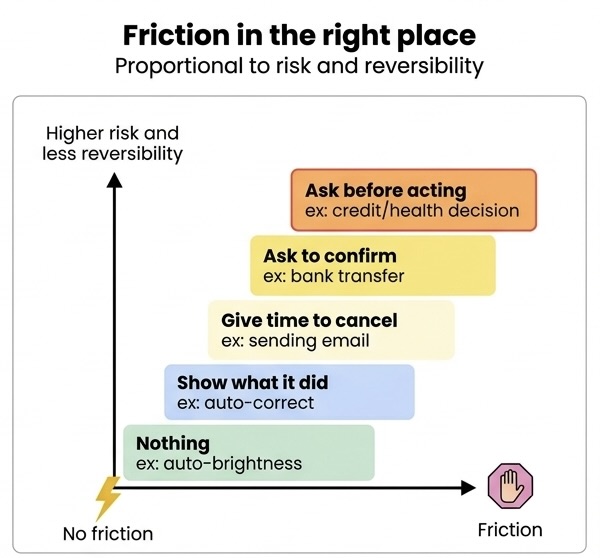
Friction in the right place. For twenty years, my profession was to remove friction. With AI, sometimes it needs to be put back. Not everywhere: in the right place. Friction proportional to risk and irreversibility:
Where an error is cheap and can be undone with a gesture, zero friction.
Where it costs money, health or rights, and can’t be reversed, the system should slow the person down: show what it deduced, ask them to confirm what matters, ask before acting.
Showing the account holder’s name before a transfer is friction. The good kind.
Friction is what separates a real human in the loop from a human who merely rubber-stamps. The European AI Act requires human oversight in high-risk systems, and many organizations will put someone in place to validate what the AI does. But if the screen invites acceptance and makes everything else laborious, oversight exists in the contract and not in practice.
There is research showing that small frictions, such as asking the person to think about their own answer before seeing the AI’s, reduce blind trust. And also that people like them less.
That is exactly why they have to be well designed, and well tested.
How to find out whether it’s really a good burger
The good news is that this doesn’t require a new science. It requires doing, with AI, what usability has always done: getting to know real people, putting products in their hands and seeing what happens.
“Research is always possible!”
It’s one of the mantras we have at Tangível. Often, “we don’t have the time or the budget” hides something else: a lack of will, of creativity or of knowledge about what each method can do with little. And some prejudices.
Risk decides the method. An AI that suggests the next song can be tested quickly, at the corner café. An AI that approves a loan or explains a Social Security letter calls for live testing, with rigor, people with the right profile and real consequences.
And what about synthetic users?
They are good for some things: generating hypotheses, testing a script before the first session, learning the vocabulary of a sector, exploring average behaviors in low-risk decisions.
They are not for deciding. And they fail precisely where our work matters most: when there is a strong emotional charge, as with an inheritance or a diagnosis; with extreme users; with groups that are already underrepresented; with emotional jobs, what people want to feel and not just do.
Studies on AI-generated personas show that they tend to be younger and more educated than real people, and that they distort more those who are already seen less.
Going into the field
This year’s theme calls for an AI that reflects the plurality of cultures and values, not a single model. That is:
local research,
with real people,
in their context.
Which is great, because if there is one thing we love at Tangível, it’s putting on the anthropologist’s suit! We have a new lab, and we love it, but fieldwork is addictive: observing people where things happen, with their hidden artifacts, their social dynamics. We like a guerrilla approach, going out to meet people. And we take recruitment very seriously, because a test is only as good as the people in it. That is also why we are part of the UX Alliance, a network of 29 UX companies: when a study spans several countries, each market is moderated by someone who speaks the language, knows the culture and picks up on the social and economic subtleties that a translator, or a model, misses.
Simulating AI failures
To test a virtual assistant, we once created audio clips that simulated its answers. It’s a Wizard of Oz test. With AI, it is the cheapest way to see what people do when the system gets it wrong with total confidence.
Testing with real consequences
Accepting a suggestion in a prototype costs nothing; when it touches your own money or your own health, trust changes. And when the product is an AI, which doesn’t always give the same answer, testing and measuring the experience is even more critical. Recently, in a digital transformation project, we gave up on an intelligent assistant and opted for a traditional wizard, because in testing people showed tremendous fears and anxieties about the AI chatbot.
Asking whether it’s needed, before building
Google’s People + AI Guidebook opens with this question: does AI add value here, or would a simple solution do? Without forgetting that today’s “wow” is tomorrow’s expectation, as Kano-san teaches us.
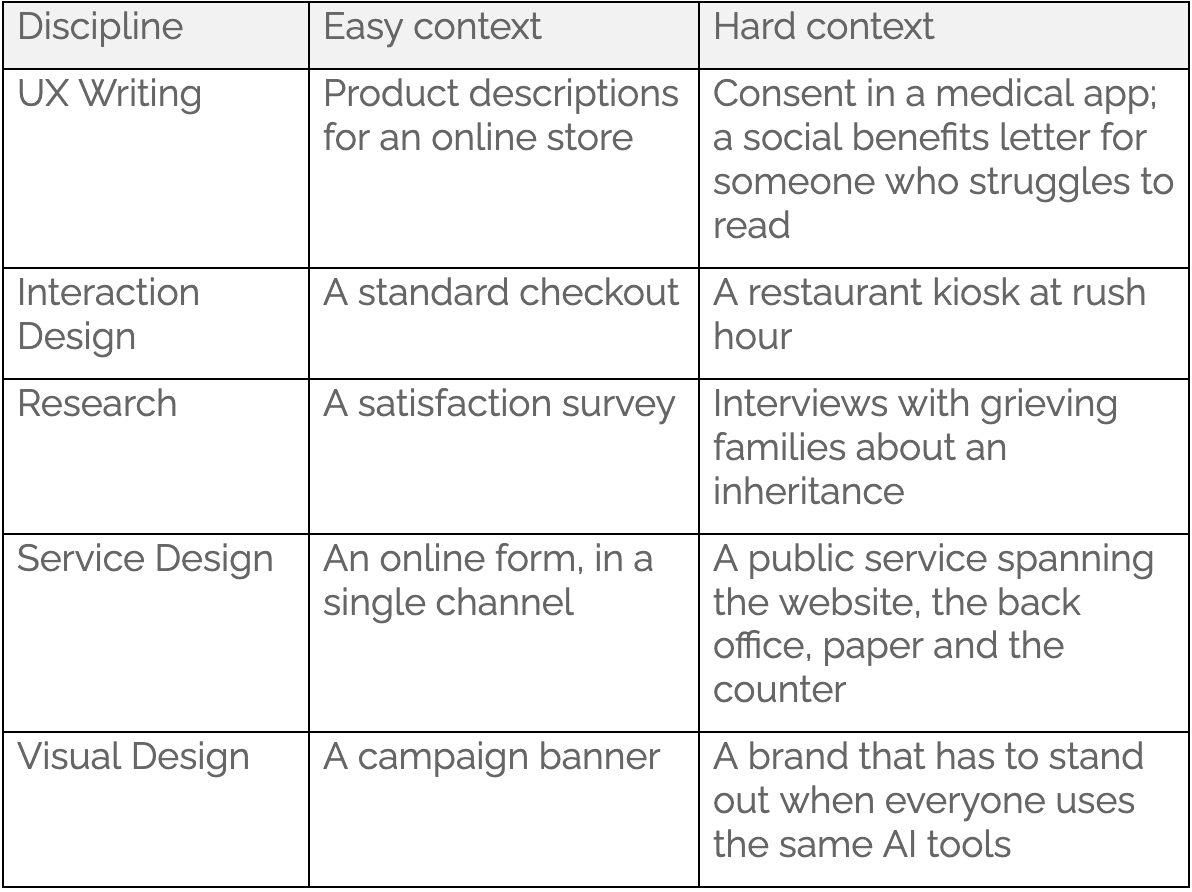
Easy or hard?
MIT researchers created the AI Decision Matrix to help companies decide how people and AI agents should take part in decisions. They use two dimensions: ambiguity and risk. At Tangível, we started from there and added what we see in the field.
And the first lesson is that the right question is not which discipline AI can replace. It’s which problem.
Currently, AI is strongest where there is more data and weakest where the internet doesn’t reach: physical systems, multichannel services, back-office software, paper.
Hard isn’t all the same
Hard to get right. It is critical or regulated, the risk is high and “good enough” won’t do. This includes making AI itself understandable, ethical and trustworthy.
Hard to make exceptional. Craft, emotion and experience really do make the difference, creating the standout, the sense of something unique and memorable, especially when everyone uses the same AI tools.
Hard to make feasible. The organization itself doesn’t yet have the maturity, culture or talent to get there.
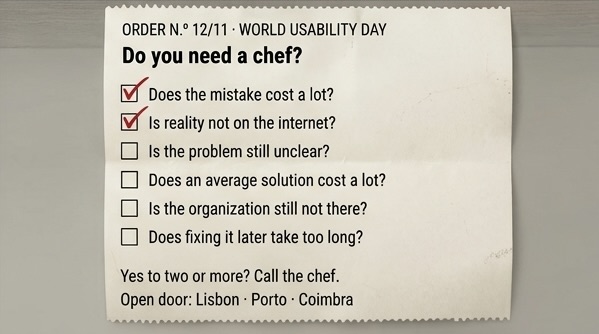
Do you need a good cook?
Six questions. If you answer yes to two of them, you probably have a hard challenge.
Does an error cost a lot? Money, rights, health or reputation. Or someone will have to validate and sign off.
Is reality not on the internet? You need to reach real users, especially hard-to-reach ones, physical environments, proprietary data or the organization’s internal context.
Is the problem still unclear? Or are there people who disagree about what it is.
Is an average solution a missed opportunity? And not merely a slightly worse solution.
Is the organization not there yet? It lacks the maturity, culture or talent to get where it needs to be.
Does fixing it later take a long time? If every improvement after launch requires a specification, a new budget or hiring someone, you need to get it right the first time.
Fine dining is just well-cooked food
There’s an episode of MasterChef Australia that I really like. A contestant is visibly nervous because the challenge is fine dining, and that’s not his thing. The chef sees it, goes over to him and says: “Sashi, calm down! Fine dining is just well-cooked food”.
The same goes for ethical AI. It isn’t a new specialty, with new consultants and new frameworks. It is usability done properly. Understanding who it’s for. Showing what the system did. Letting people disagree. Letting them undo. Not blaming those who use it. Not building what nobody needs. And testing all of this with real people, in the real world.
None of this is new. What is new is the scale: what used to be a problem for airline pilots and power plant operators is now in everyone’s pocket. The principles are old. Applying them to systems that change with every use is new.
AI alone does not create useful, usable, trustworthy, engaging and distinctive products. That is why, after 21 years, we are still celebrating World Usability Day. Not because interfaces arrive late, but because they keep arriving full of usability problems.
Our door is open
Our door is always open: Lisbon, Porto and Coimbra. Come and chat. If you answered yes to two of the six questions, or if your challenge is hard to get right, hard to make exceptional or hard to make feasible, come talk to us. Bring your AI product, or your challenge, and we’ll look at it together, in the hands of a real person. Borrow Norman’s book on your way out.